

In Douglas Adams' classic, The Hitchhiker's Guide to the Galaxy, the supercomputer Deep Thought reveals the Answer to the Ultimate Question of Life, the Universe, and Everything: 42. The problem? The answer is meaningless without knowing the question.
We are at a similar juncture with AI. Faced with powerful new "answers," our most urgent task is to discover the questions to ask about ourselves and this technology.
The following is drawn from conversations on this subject between Mohak Shroff (Mohak) (a tech executive seeking to build a better Artificial Intelligence) & Sadhu Aksharananddas (AAD) (a philosopher steeped in Indian and Western thought). We have polished only for clarity—every idea lives in the original tape. Mohak plays the narrator through this article, and we begin at the launch of the modern AI revolution.
The Existential Thrum
Back in 2022, I sat in a small conference room watching an early preview of ChatGPT. A developer suggested, “Try asking it to compose something.” I typed: Write me a poem about curiosity on a rainy night. Several seconds later: four crisp stanzas, original imagery, and a closing twist that took me completely by surprise.
I went home feeling somewhat in awe, somewhat in shock, and somewhat thoughtful about what it all meant. I wasn’t convinced it wasn’t just a neat technical trick. I’d seen things like Eliza before, and maybe this was more of the same - a cool technical toy that wasn’t actually “smart”. I went back to the model to test it some more, and it spat out variations that felt fresh every time. But it did so much more. It summarized globs of text I pasted in; it had access to what felt like all human knowledge and was answering all sorts of questions, even those about obscure topics. It felt… intelligent.
Right there, in that moment, my view of the world shifted. If an algorithm can create at will, what becomes of human ingenuity? If one day an AI knows more than me, what does that say about the intelligence I’ve always thought of as uniquely human, or uniquely me? A question that began as a professional curiosity quickly became a matter of personal identity. And then came the realization that many others would be asking these same questions when they experienced what I just had.
In tech, we’re trained to metabolize novelty—ship, measure, iterate—but with generative AI, the novelty is about us. The conversations I tend to hear about AI are frequently dystopian, charts of benchmark curves, and headlines about “super-human performance.” One AI test even calls itself “Humanity’s Last Exam.” Language like this solves no mysteries; it amplifies the existential thrum.
As time passes and AI chatbots become more integral to our productivity and workflows, these questions grow in urgency and importance.
Reaching Beyond the Echo Chamber
When grappling with thoughts like these, I reach for older frameworks—spirituality and philosophy—to help ground my thinking and provide different perspectives. Someone who I’ve called many times before is a friend who straddles both domains. Swami Aksharananddas (AAD) is a philosopher and educator specializing in both Western analytical philosophy and Indian thought. His training in computer science proves particularly relevant in this conversation. When I first shared these thoughts and experiences with him, he responded:
AAD:
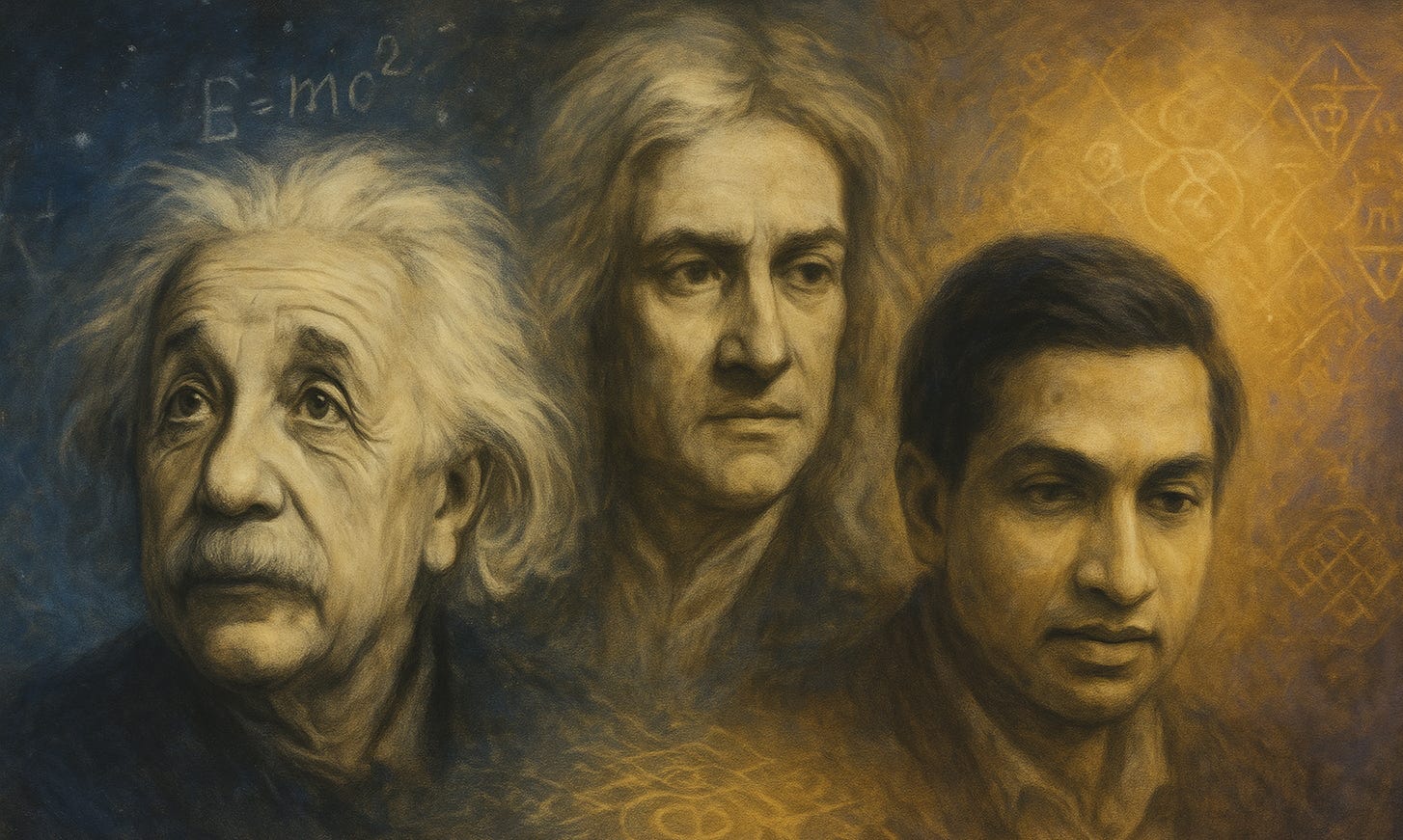
Your instinct is revealing. There doesn’t need to be a hard line between physics and metaphysics. Aparā-Vidyā (knowledge) and parā-vidyā (higher knowledge) are understood as being one arc. Even the sciences embraced this reality. Einstein spoke of a “cosmic religious sense” when witnessing the order of the universe. Newton wrote on theology in addition to calculus, while Ramanujan found mathematical inspiration from the goddess Namagiri. On a personal level, both of us have experienced our guru, Mahant Swami Maharaj, guiding us to complement innovation with spiritual growth.The conversation we are having, therefore, isn’t new. The object—AI, an artefact that mimics the mind—is new. And its newness forces us to revisit metaphysical grounds by urging us to ask questions that we would not have asked otherwise.
So, while the AI debate often toggles between boosterism (everything will be fine) and apocalyptic scenarios (the robots will get us), ancient traditions offer a third posture: contemplative inquiry. They teach that technological intensity and peace can coexist by integrating scientific and spiritual principles—philosophy gives us a compass, while engineering gives us a map. My first waypoint is transformer models, and how their predictions feel like thought.
The Temptation to Anthropomorphize
Mohak:
Here’s my technical itch. These transformer models ingest an immense amount of content and learn that after the word ‘the’, ‘dog’ is likely, ‘person’ is plausible, and ‘photosynthesis’ is rare. During generation, the model samples across that probability space; no inner life required. But subjectively, the outputs feel coherent, even intentional, the result of thinking. Is what we see from these models a blueprint for human thought? I also absorb language, store impressions, and produce sentences in reaction to my circumstances and stimuli. Am I just a higher-order predictor?
AAD:
These are important questions, but before we can get to transformer models, there is something subtle at play that we should address. The minute we say “thinking,” “remembering,” or “reasoning,” we import centuries of human history, tradition, and reflection. You have probably heard the phrase “category error”—something that is miscategorized because it fails to neatly fall into a defined framework. Early explorers encountered a platypus and misidentified it because the term ‘monotreme’ didn’t yet exist. Thomas Kuhn argued that when a new scientific innovation appears, the language stretches until it snaps or becomes “incommensurable.” Taking an example from physics, for centuries, experimenters tried to force light into a familiar binary: either a particle or a wave. Experiments showed, however, that it displayed properties of both. How could that be? The impasse was only resolved by introducing an entirely new way of thinking and a new language to describe it. Science now describes the phenomenon using the language of quantum mechanics, introducing language like ‘photon’ and ‘super-position’. The question, “wave or particle?” was realized as being mis-asked.Calling GPT “intelligent” may be such a placeholder, as modern language does not have a good way to label it.
Words are accompanied by entire histories, frameworks, values, and even limitations. The words we use matter. They influence our willingness to accept, integrate, and adapt, and they affect our attitudes and anxieties. They also provide direction for our investigations. And many times, even if they don’t fit, we use them as placeholders to help us simply communicate. The important thing is to be aware of this. So we mark the new artefact with an asterisk; in the case of GPT: intelligent, but only by analogy.
When we stop treating AI as mysterious or magical and look at how it actually works: by processing patterns, storing and retrieving data, and updating it through training, we become clearer about what it is and is not. This helps us appreciate its strengths, without mistaking the analogy for an identity. This clarity keeps both the hype and fear in check, letting us see the phenomenon as it exists and helping us respond to it without being too quick to embrace extremes.
Muddle & Meaning
AAD:
There’s a hidden upside to the linguistic muddle. Mislabeling, when recognized, instigates a tension, which sparks conversation. By calling specific integrated transformer functions “thinking,” we’re pushed to define what human thinking and cognition actually entail. It inspires us to question whether and, if so, what role embodiment, emotion, goal-directedness, maybe even human conditions, like forgetting and suffering, play.This unease mirrors the experience of spiritual traditions, which, in seeking to convey the transcendental, recognize the limits of language and turn to more abstract or metaphorical expressions found in poetry.
Mohak:
For society at large, the language and, more broadly, concepts we use shape perception, and they shape emotion. How we define terms like ‘intelligence’, ‘agency’, or ‘mind’ changes how we see machines, how we see each other, and even how we understand ourselves.These definitions also have a powerful impact on our relationships: with AI, with fellow humans, and with ourselves, and in turn, they guide our behaviors toward all three.
And the stakes aren’t solely intellectual. If a factory worker is replaced by a welding robot, they may not care whether the machine has intentionality, whether it actually thinks or has feelings. For them, outcome trumps ontology.
So the two tracks must run in parallel:
Impact track (boots-on-ground): How shifting thinking ripples outward, reshaping how we work with AI, who benefits, who’s left behind, and how individuals, institutions, and cultures are formed and respond.
Concept track (blueprints-in-hand): The complicated task of discovering philosophical frameworks to encompass these new artifacts, and refining or redefining words like ‘mind, ‘agency, and ‘creativity’ to better communicate them.
Ignore either, and the other becomes harder. Miss the impact layer, and we are misled, or worse, suffer. Miss the concept layer, and the tools we use to conceptualize, communicate, and mediate become blunt instruments.
The early days of technological innovation are often filled with learning experiences and transition periods. It takes time for us to find a place for ourselves and our way of life, and to adapt our social and economic models to the new worlds we create. What we seek to do in this series is address this moment—to ask the right questions and navigate to better answers about the artificial superintelligence we create and, most importantly, our sense of place and self. We hope you find value in these conversations as we continue to venture Beyond 42 and into the space of Parā Technica.
Thank you for initiating this important conversation. Having Swami Aksharananddas’s perspective on how spiritual traditions have historically engaged with paradigm-shifting breakthroughs is a vital step toward ensuring we approach this moment with depth and wisdom.
Technology without philosophy is a hammer without a wielder.” Spot on!
Para-Technica: Beyond 42" reframes how I perceive and use AI, urging a blend of philosophy with tech’s raw power.
This hits home, I have watched tech evolve in pharmacovigilance from book logs to predictive analytics. Yet, true progress needs the interdisciplinary soul the article calls for melding code with human consciousness. It’s about crafting questions that respect our vulnerabilities, not just chasing answers.
For life sciences leaders and tech thinkers: How can we shape tools to create safer products? Grateful for this spark! let's entangle ideas! #Pharmacovigilance #TechEthics #ParaTechnica